For most of my life, I hadn’t considered what it would mean to be both vegan and a Muslim, or the challenges posed by holding those identities together. That changed when I was invited to Turkiyë for the first-ever Green Islam summit, where I watched faith begin to reconcile with environmental activism.
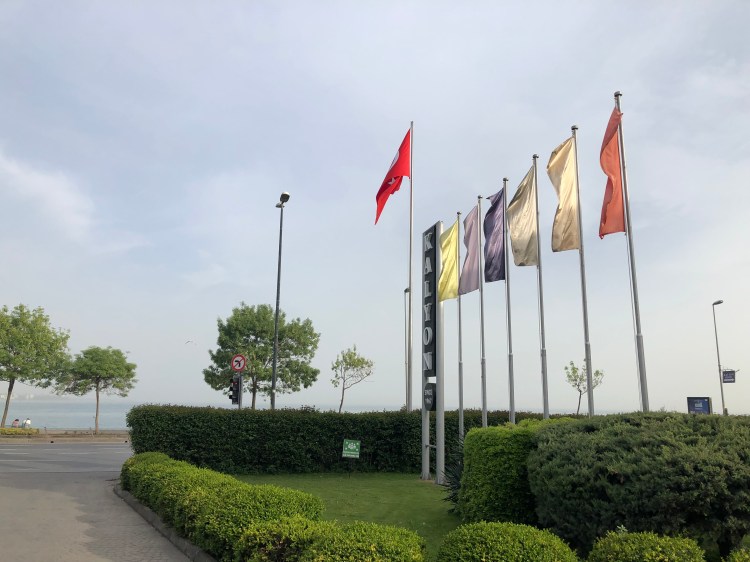
This Earth Day, I sat in a taxi with two other summit participants, bumping through the city on our way to a hotel. Altamush is an animal rights lawyer; we bumped along the road as he described building drinking fountains for local animals in his Pakistani village, smiling with his eyes. Aryanna is a disarming representative of Studio 28, a non-profit vegan café and community space in Toronto, Canada. She was open in a way that made me want to be bolder. We talked the whole journey before pulling into our coastal hotel without an idea what the next few days held.
Green Islam is an organisation dedicated to harmonising Islamic values with environmentalism. It’s spearheaded by co-founders Zehra Abbas and Ellie Atayee-Bennett, who organised the summit and greeted us upon arrival. Talking to them, I learnt that this group was originally formed not as a vehicle for socio-political change, but as a safe space.
Day One
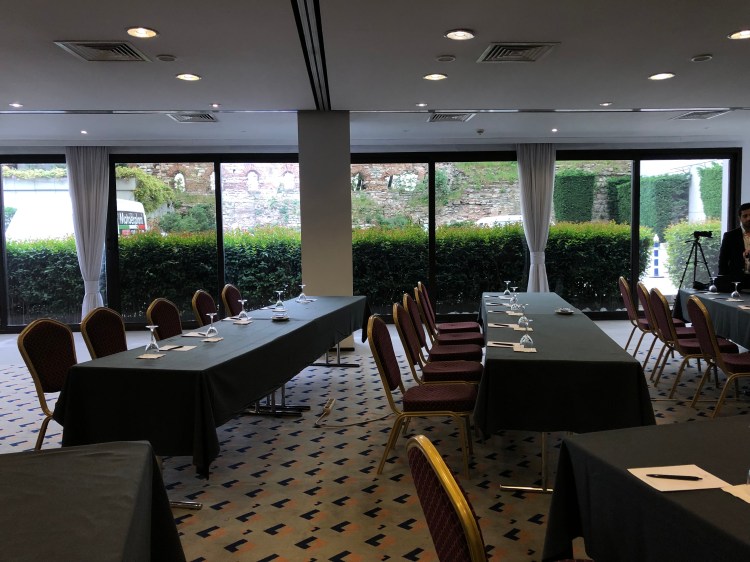
Upon entering the workshop room, I watched as strangers took their seats and exchanged brief introductions with each other. There was a hum of anticipation as Zehra and Ellie set up their presentation. I watched their eyes scan the room. Months of hard work had led them here – thirty-five people from twenty-two countries, together in one room. It was a feat before it had even begun.
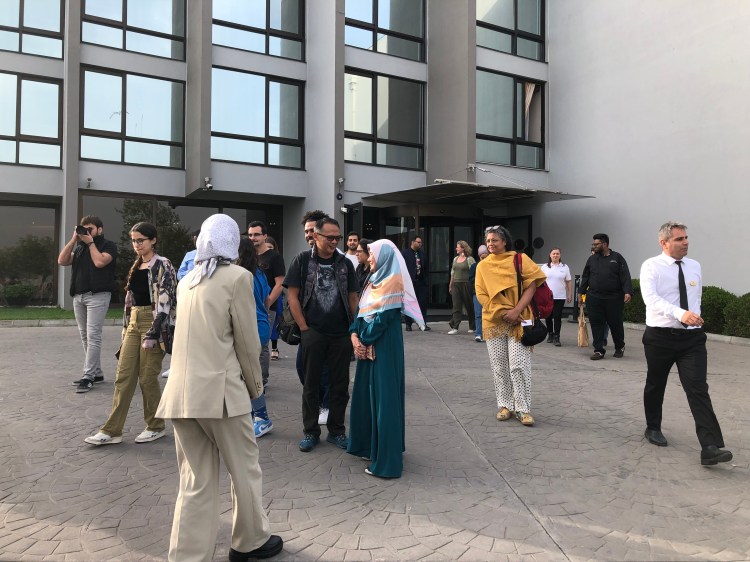
The event began with Zehra asking the group to name their motivations for attending. Some felt called Islamically, some fuelled by personal experience of injustice, but all by a common duty to the planet and one another. They identified a few goals for Ellie to write on a big, rolling whiteboard. It remained in the corner of the room for the duration of the summit, anchoring the days in purpose.
Those goals were not just semantic. Observing this group for even an hour, you will see people pouring water for their table-mates, filming each others’ presentations, and offering words of support during emotional conversations. It was clear from that first taxi journey. These goals—compassion, justice, and stewardship—became the guiding principles for the days ahead, reflected in every interaction.
Activism can be exclusionary. I watched the co-founders recount their experiences of perfectionism, burnout, and loneliness, and my belief was affirmed – the path of advocacy is not an easy one. These few days on the Istanbul coast existed to forge a global network of activists, scholars, and business people, but more importantly, to remind them of their community. It was clear from the start that they wanted to build something new. A space to “fight against infighting”, in Zehra’s words. It wasn’t about common goals, as much as you might think – not to convert or preach – it was just a place to feel less alone.
Veganism in Islam
I, like many others, hadn’t taken the time to question how veganism and Islam interacted with one another. I found it difficult to separate the faith from the culture. Many people consider meat to be bounty, or tie animal sacrifice to religious events like Eid al-Adha. Naively, I assumed the two ways of life were inherently in conflict.
That day, speakers shared how they were questioned by members of the wider community. “What about halal meat?”, they heard. Faith-based environmentalism was dismissed as ultra-modern by meat-eaters, and unscientific by atheists. It was considered incompatible at best, and threatening to the movements’ integrity at worst.
Imam Talha Taskinsoy, a traditional scholar and dedicated vegan, challenged these assumptions directly. Supported by scripture, he outlined the concepts of halal (permitted) and tayyib (encouraged). “The two are often confused”, he told us – “while meat consumption is allowed, Islam emphasises mercy and stewardship.”
He referred to the treatment of animals by Islam’s Prophets, and hadiths (sayings of the Prophet) that taught mercy. Veganism wasn’t a rejection of faith, or a colonial import – rather, an embodiment of Islam’s most foundational beliefs. A divine duty. The question was no longer “How can I harmonise these movements?”, but “How can we use faith to be better stewards?”
The day ended with a group meal in the dining area. All lunches and dinners were vegan interpretations of traditional Turkish foods. I sat by the window, listened to my curious peers and watched the dolphins jump over the ocean.
Day Three
That afternoon, the co-founders crafted an empathy exercise for us to conduct. We were told to put ourselves in the shoes of people we wouldn’t usually – people from different countries, of different ages, and crucially, people on opposite ends of the political spectrum. The room fell quiet as people slipped out of the back door. Emotions were high – people were having private conversations and shedding tears. From a sincere but hurtful mistake, the support of the group could’ve easily been dismantled – instead, the commitment to empathy I wondered might have been idealistic was proved to be true.
Instead of brushing the conflict aside, Zehra, Ellie, and Imam Talha confronted it directly, turning the moment into a powerful lesson in kindness and accountability. After a short break, they issued responsible apologies to individuals and the wider group. A decision was made to facilitate a spontaneous conflict resolution session using the teachings of the past few days.
It was the hard way through. Everyone in the room felt it. They were emotionally and physically exhausted, but nobody complained. Participants aired their grievances in objective but honest ways, not shying away from their feelings and remaining remarkably measured. I thought it was courageous – between outdoor breaks and shy sips of water, we spent the hour talking openly. They leaned into the discomfort because they felt they owed it to one another. Not one person spoke without the room shuffling their chairs to face them.
In that moment, I saw environmentalism and Islam as fundamentally entangled. The exercise laid bare those shared values – justice, and compassion.
A Duty to Care
It didn’t take long to change people. After three days, even our camera crew left with new commitments to veganism. Over just three days, Zehra and Ellie’s dream of creating a community for themselves came to life.
Zehra had previously shared with me her inspiration for founding Green Islam. As an openly vegan Muslim in Canada, her group was not easy to find. She is no stranger to the feeling of isolation. She and Ellie built this project from the ground up to provide people with the community she so craved, and it took only three days for it to manifest.
This diverse collective had been subject to misunderstanding their entire lives, whether as Muslims, women, or environmentalists. Where the world labelled them judgemental, they showed dedication to understanding and accepting their peers in no diluted way. They were willing to sit in painful emotions if it meant strengthening their bonds. What I witnessed here was defiant, and it was hopeful.
The events of my three days in Istanbul reaffirmed my belief that we must lead with empathy to make real change. In the eyes of the participants, rooted in veganism and Islam, I saw the power of community and our duty to care for the world and all its beings.
 The Forward Collective